

December 2025 Market & Economic Recap: Insights for the New Year
- Will Snodgrass
- Jan 12
- 7 min read

As we turn the page to 2026, it's natural to reflect on the markets and economic conditions that shaped December 2025: and more broadly, the entire year. For investors who entrust us with their financial stewardship, understanding these patterns isn't just about numbers on a screen; it's about gaining wisdom for the journey ahead.
December 2025 capped off what many would describe as a remarkable year for equity markets, though one filled with unexpected twists that remind us why maintaining a long-term perspective remains so crucial to faithful stewardship.
A Year of Strong Returns and Shifting Leadership
The headline numbers from 2025 tell a compelling story. The S&P 500 finished the year up 17.8%, while the technology-heavy Nasdaq delivered even stronger gains of 21.8%¹. Perhaps more striking was the performance of international markets, with Emerging Markets leading the way at 29.7% and developed international markets (EAFE) posting impressive 28.2% returns¹.
But December itself revealed an important shift in market leadership that caught many observers' attention. While large-cap technology stocks had driven much of the year's gains, December saw smaller companies take center stage. The Russell 2000 small-cap index actually set record highs, signaling a rotation from mega-cap growth stocks to smaller, more domestically-focused companies².
This shift challenges the common assumption that markets move in predictable patterns. Historically, the final months of the year: often called the "Santa Claus Rally": tend to favor large-cap stocks. Yet 2025 defied convention in multiple ways: May delivered spectacular gains when it's typically more modest, while September and October (historically weaker months) posted gains³.

Economic Conditions: Mixed Signals Amid Uncertainty
Beneath the market's surface, economic conditions painted a more nuanced picture. The labor market, often considered the backbone of consumer spending, showed conflicting signals throughout December. On one hand, jobless claims fell to a seven-month low: typically a positive indicator². However, broader hiring trends suggested a cooling economy, with the ADP survey pointing toward 32,000 jobs lost in November⁴.
Consumer sentiment fell to its lowest level since 2022, with spending patterns revealing a concerning bifurcation². Lower-income households faced particular strain, while affluent consumers continued to benefit from three years of solid market returns⁵. This divide underscores why economic indicators rarely tell a complete story on their own.
Inflation remained a persistent concern, though progress continued on a gradual path toward the Federal Reserve's 2% target. Private indicators showed inflation moderating in recent months, but the process remained slower than many had hoped⁶. The ongoing tension between price pressures and economic growth reminded investors why predicting near-term economic outcomes remains so challenging.
Adding to the uncertainty, a prolonged government shutdown created a 43-day data blackout that heightened macroeconomic uncertainty². When reliable economic data becomes scarce, markets often respond with increased volatility: a reminder of how external events can impact investment environments in unexpected ways.
Federal Reserve Policy and Interest Rate Environment
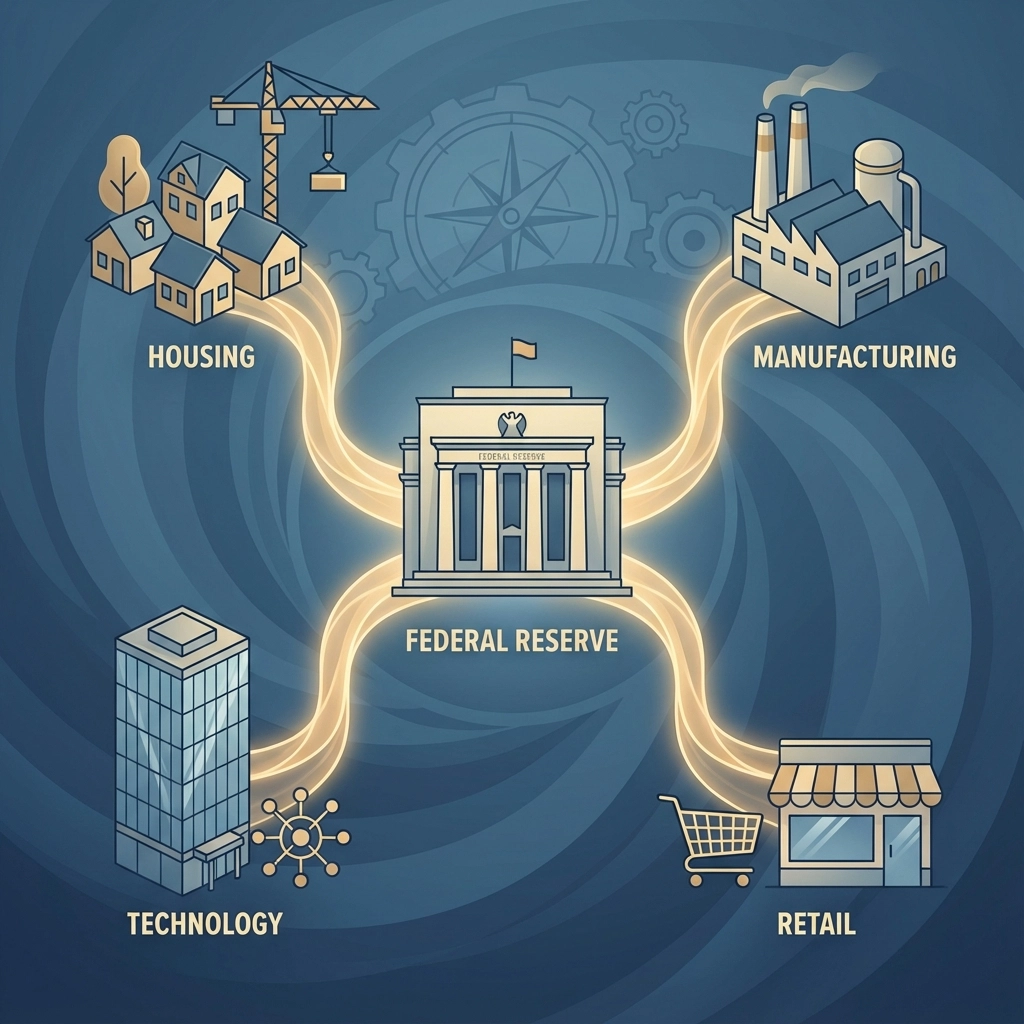
The Federal Reserve continued its measured approach to monetary policy, delivering its third consecutive rate cut in December³. This decision came with expectations of achieving a "soft landing": the delicate balance of cooling inflation without triggering a significant economic downturn.
The Fed's December projections offered insight into their thinking for the year ahead. They revised 2026 growth projections upward from 1.8% to 2.3%, partially reflecting economic activity that was delayed due to the government shutdown but expected to shift into early 2026⁷. The median projection for the policy rate at the end of 2026 stood at 3.4%, suggesting a continued gradual approach to rate adjustments⁷.
These projections remind us that even the most sophisticated economic forecasting involves significant uncertainty. The Fed's own track record shows how challenging it can be to predict the precise timing and magnitude of economic changes, which is why investors benefit from maintaining diversified, long-term strategies regardless of short-term policy shifts.
Fixed Income and Alternative Asset Performance
While equity markets captured most headlines, fixed income markets delivered exceptional results that many investors may have overlooked. Taxable intermediate bonds returned 7.3% year-to-date: on pace for their best performance since 2002⁵. Treasury yields declined meaningfully, with the 10-year Treasury ending at 4.01% and the 2-year at 3.49%².
This bond performance serves as a valuable reminder of why diversification matters. In years when one might expect bonds to struggle due to changing interest rates, they actually provided both income and capital appreciation for patient investors.
Alternative assets showed more mixed results. Gold surged 5.9% to reach $4,239 per ounce, continuing its role as a potential hedge against uncertainty². Meanwhile, cryptocurrencies faced headwinds, with Bitcoin declining 16.7% and Ethereum falling 21.7%² during December: a stark reminder of the volatility inherent in these newer asset classes.
Historical Context: What Past Patterns Teach Us
When we examine market and economic history, certain patterns emerge that can inform our perspective without making specific predictions about future performance. Markets have historically shown resilience over long time periods, though the path is rarely smooth or predictable.
The shift in market leadership we witnessed in December: from large-cap technology to small-cap stocks: reflects a pattern that has repeated throughout market history. Leadership rotations often occur when investors begin questioning whether certain sectors have become overvalued relative to others, or when economic conditions favor different types of companies.
Similarly, the mixed economic signals we observed in December align with historical patterns during economic transitions. Rarely does an economy move smoothly from one phase to another. Instead, we typically see conflicting indicators as different sectors and regions adjust at varying speeds.
The Federal Reserve's gradual approach to policy adjustments also follows historical precedent. Central banks have learned from past experiences that dramatic policy shifts can create unintended consequences. Their measured approach reflects lessons learned from previous economic cycles.
A Stewardship Perspective on Market Uncertainty
For those of us committed to biblical financial stewardship, periods of mixed signals and uncertainty present both challenges and opportunities for growth. The book of Proverbs reminds us that "The plans of the diligent lead surely to abundance, but everyone who is hasty comes only to poverty" (Proverbs 21:5).
This wisdom applies directly to investment stewardship. While it's natural to feel concerned when economic data sends conflicting signals, or when market leadership shifts unexpectedly, these periods often reward those who maintain discipline and focus on long-term principles rather than short-term emotions.
The December market rotation from large-cap growth to small-cap stocks, for instance, reminds us why maintaining broad diversification serves investors well. Those with portfolios concentrated in a few sectors or company sizes might have experienced more volatility than those with balanced, diversified approaches.

The bifurcated consumer spending patterns we observed: with affluent households continuing to spend while lower-income families struggled: also highlight the importance of considering the broader economic context when making financial decisions. What affects one segment of the population may not affect another in the same way.
Preparing for 2026: Principles Over Predictions
As we look toward 2026, the temptation exists to make specific forecasts about market direction, economic growth, or Federal Reserve policy. However, December 2025's mixed signals remind us why such predictions often prove unreliable.
Instead of focusing on predictions, wise stewardship emphasizes timeless principles that have served investors well across various market and economic environments:
Diversification remains crucial. The strong performance of international markets in 2025, combined with December's rotation toward small-cap stocks, reinforces why spreading investments across different asset classes, company sizes, and geographic regions can help reduce overall portfolio volatility.
Long-term perspective provides stability. While short-term market movements and economic data releases can feel important, successful investing typically rewards those who maintain focus on longer-term goals rather than reacting to every piece of news.
Regular rebalancing maintains discipline. When certain investments significantly outperform others: as international stocks did relative to U.S. large-caps in 2025: periodic rebalancing helps ensure portfolios don't become overly concentrated in any single area.
Quality over speculation serves investors well. The cryptocurrency declines in December, contrasted with the steady performance of diversified stock and bond investments, highlight why building portfolios around established asset classes often provides more reliable long-term results than chasing speculative trends.
The Importance of Professional Guidance
The complexity revealed in December 2025's economic and market conditions underscores why working with qualified financial professionals becomes increasingly valuable. When government shutdowns create data blackouts, when market leadership shifts unexpectedly, and when economic indicators send mixed signals, having experienced guidance helps investors maintain perspective and avoid reactive decisions.
Professional advisors can help interpret complex economic data, maintain portfolio diversification during periods of uncertainty, and most importantly, keep long-term goals in focus when short-term events create anxiety or excitement.
For those committed to faith-based financial stewardship, working with advisors who understand both sound financial principles and biblical wisdom about money management provides additional value. This combination helps ensure that investment decisions align not just with financial objectives, but with deeply held values about stewardship and generosity.
Ready to discuss how these market and economic insights apply to your personal financial stewardship in 2026? At Matt25 Capital, we specialize in helping Christians navigate complex financial decisions while staying true to biblical principles of stewardship. Whether you're concerned about market uncertainty, interested in faith-based investing approaches, or simply want to ensure your financial plan aligns with your values, we're here to help.
Schedule a conversation with our team to explore how faithful financial stewardship can provide both peace of mind and financial progress in the year ahead.
Important Disclosures: This material is for general information and education purposes only. Information is based on data gathered from what we believe are reliable sources. It is not guaranteed as to accuracy, does not purport to be complete and is not intended to be used as a primary basis for investment decisions. It should also not be construed as advice meeting the particular investment needs of any investor.
The information presented herein reflects information available as of the date of publication and may change without notice. Past performance is not indicative of future results. All investments involve risk, including potential loss of principal.
Matt25 Capital is not a registered investment advisor. Securities and advisory services offered through Commonwealth Financial Network®, Member FINRA/SIPC, a Registered Investment Adviser.
References:
Market performance data from financial market reports, December 2025
Economic indicators and market analysis, various financial publications, December 2025
Federal Reserve communications and market analysis, December 2025
ADP Employment Report, November 2025
Consumer sentiment and bond market data, December 2025
Inflation and economic growth projections, Federal Reserve, December 2025
Federal Reserve economic projections, December 2025

Comments