A plain walk through the chapter our name comes from: what Jesus said, where He said it, and how the three passages fit together.
Matthew 25 is the closing chapter of Jesus' last long teaching before His arrest. It holds three passages: the parable of the ten virgins (verses 1-13), the parable of the talents (verses 14-30), and the judgment of the sheep and the goats (verses 31-46). All three answer the same question: how should Jesus' followers live while they wait for Him to return? Be ready, be faithful with what He has entrusted, and care for "the least of these."
| Verses | Passage | Key verse (ESV) | Main lesson |
|---|---|---|---|
| 25:1-13 | The ten virgins | "Watch therefore, for you know neither the day nor the hour" (25:13) | Be ready now. Readiness cannot be borrowed. |
| 25:14-30 | The talents | "Well done, good and faithful servant" (25:21) | Be faithful with what God entrusts. Do not bury it in fear. |
| 25:31-46 | The sheep and the goats | "You did it to me" (25:40) | Love for Christ shows up as mercy to the least. |
Matthew 24 opens with Jesus leaving the temple and telling His disciples it will be torn down. Sitting on the Mount of Olives, they ask Him privately, "Tell us, when will these things be, and what will be the sign of your coming and of the end of the age?" (Matthew 24:3). Chapters 24 and 25 are His answer.
Matthew 24 ends with a clear warning, "concerning that day and hour no one knows" (24:36), and a short picture of a "faithful and wise servant" who is found doing his job when his master comes back (24:45-51). Matthew 25 then unfolds that idea in three scenes. Right after the chapter, Matthew 26 begins: "You know that after two days the Passover is coming, and the Son of Man will be delivered up to be crucified." These are some of the last public words Jesus taught before the cross.
Ten young women, bridesmaids in a wedding party, take their lamps and go out to meet the bridegroom. Five are wise and bring extra oil. Five are foolish and bring none. The bridegroom is delayed, and they all fall asleep. At midnight comes the cry, "Here is the bridegroom!" The foolish find their lamps going out and ask to borrow oil, but the wise cannot spare it. While the foolish go to buy, the bridegroom arrives, "and those who were ready went in with him to the marriage feast, and the door was shut."
Meaning: readiness for Christ's return is personal and cannot be borrowed from someone else at the last minute. Read the full explanation of the ten virgins.
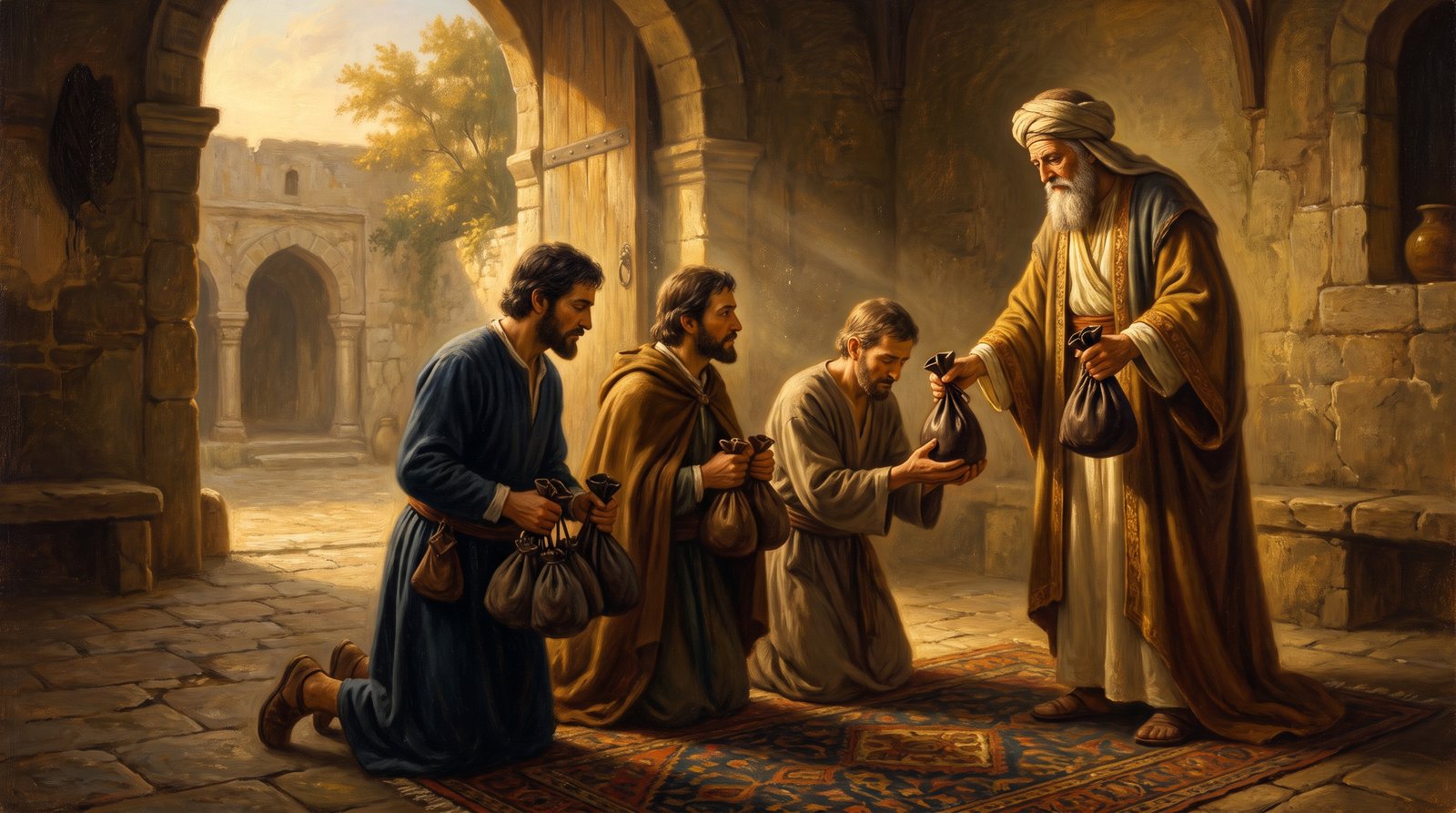
A man going on a journey entrusts his money to three servants: five talents, two talents and one talent, "to each according to his ability." A talent was a huge sum, about 20 years of a laborer's wages. The first two servants trade with the money and double it. The third buries his in the ground. When the master returns "after a long time," he tells the first two, "Well done, good and faithful servant," and invites them into his joy. The third admits, "I was afraid," and is condemned as "wicked and slothful."
Meaning: everything we have is entrusted by God, and He looks for faithful use, not fearful hiding. Read the full guide to the parable of the talents, or see what a talent was worth.
The Son of Man comes in glory and sits on His throne, and all nations are gathered before Him. He separates them "as a shepherd separates the sheep from the goats." To those on His right He says, "I was hungry and you gave me food, I was thirsty and you gave me drink, I was a stranger and you welcomed me." Surprised, they ask when they ever did this. He answers, "Truly, I say to you, as you did it to one of the least of these my brothers, you did it to me." Those on His left neglected the same needs, and they are sent away.
Meaning: genuine faith shows itself in practical mercy, and Christ counts that mercy as done to Him. Read the full explanation of the sheep and the goats.
Each passage looks at waiting for Christ from a different angle:
The three also share a pattern. There is a delay ("the bridegroom was delayed," "after a long time"). There is a sudden return. And there is a separation that reveals what was true all along. In each one, the people who are found faithful are surprised by joy: they go in "to the marriage feast," "into the joy of your master," and into "the kingdom prepared for you from the foundation of the world."
Quotations from the English Standard Version (ESV).
Matt25 Capital is named after the Parable of the Talents in Matthew 25. In that passage, Jesus tells of a master who entrusts his servants with resources and returns to see what they did with them. Put the two passages side by side and a picture of stewardship forms. We are trusted with resources (the talents), and a major purpose of those resources is caring for others (the least of these). That is why we believe giving belongs inside a retirement plan, not outside it.
Read more on our About page, or see how the parable applies to retirement in The Parable of the Talents and Your Retirement Plan.
Matthew 25 is about how Jesus' followers should live while they wait for His return. It contains three passages: the parable of the ten virgins (readiness), the parable of the talents (faithful use of what God entrusts), and the judgment of the sheep and the goats (care for "the least of these").
The ten virgins (Matthew 25:1-13), the talents (Matthew 25:14-30), and the sheep and the goats (Matthew 25:31-46). The third is often counted as a parable, though it is mostly a direct description of the final judgment that uses a shepherd image.
Be ready, be faithful, and love the least. The Son of Man will return at a time no one knows, and how His people wait matters: with prepared hearts, with faithful use of what He has given, and with practical mercy toward people in need.
"Truly, I say to you, as you did it to one of the least of these my brothers, you did it to me." Jesus identifies Himself with the needy and with His followers, so acts of mercy toward them are received as done to Him.
"Well done, good and faithful servant. You have been faithful over a little; I will set you over much. Enter into the joy of your master." It is the master's praise for the servant who put five talents to work.
"Watch therefore, for you know neither the day nor the hour." Since no one knows when Christ will return, His followers are to stay ready at all times rather than plan to get ready later.
On the Mount of Olives, east of Jerusalem, a few days before His crucifixion. Matthew 24 and 25 together are often called the Olivet Discourse. Matthew 26 opens with Jesus saying the Passover is two days away.
Our name comes from Matthew 25 and its picture of faithful stewardship. Matt25 Capital is named after the Parable of the Talents in Matthew 25. In that passage, Jesus tells of a master who entrusts his servants with resources and returns to see what they did with them.
This page is for education only and is not individualized tax, legal or investment advice. Mention of any designation or directory is not an endorsement.
Securities and advisory services offered through Commonwealth Financial Network®, Member FINRA/SIPC, a Registered Investment Adviser. Fixed insurance products and services are separate from and not offered through Commonwealth.
The Financial Advisor(s) associated with this website may only discuss or transact business only with residents in which they are properly registered. No offers may be made or accepted from any resident of any other state. Please check FINRA's BrokerCheck for a list of current registrations. Information presented on this site is for informational purposes only and does not intend to make an offer or solicitation for the sale or purchase of any product or security.
Investments are subject to risk, including the loss of principal. Environmental, social, governance (ESG) and faith-based criteria is based on a set of nonfinancial principles in addition to financial principles used to evaluate potential investments. The incorporation of nonfinancial principles can factor heavily into the security selection process. The investment's focus may limit investment options available to the investor. Past performance is no guarantee of future results. Form CRS: Client Relationship Summary
Certified Financial Planner Board of Standards Inc. (CFP Board) owns the CFP® certification mark, the CERTIFIED FINANCIAL PLANNER™ certification mark, and the CFP® (with plaque design) logo in the United States, which it authorizes use of by individuals who successfully complete CFP Board's initial and ongoing certification requirements.
Matt25 Capital is a separate entity from Commonwealth Financial Network®.