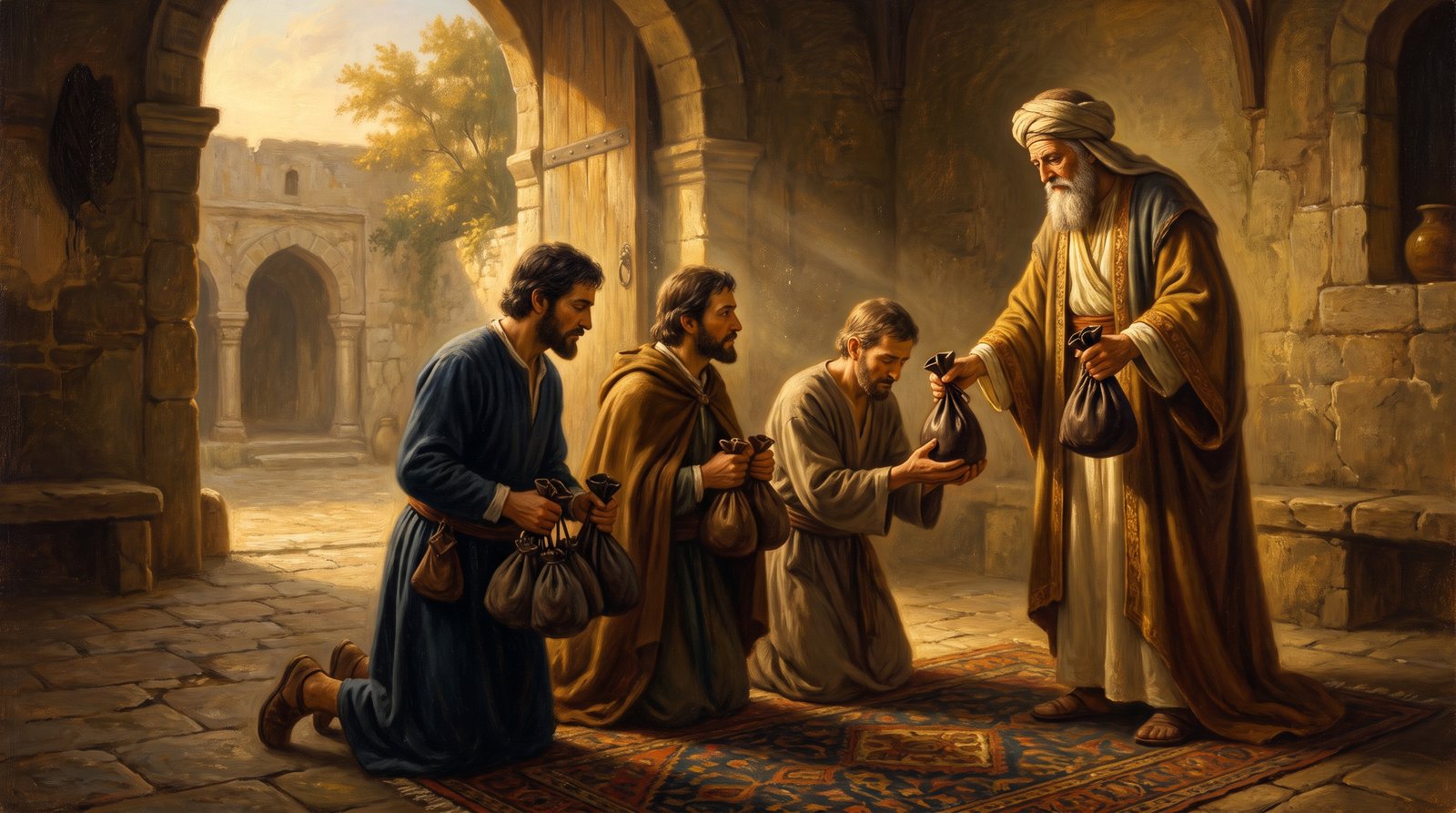
What Jesus meant when He told of five talents, two talents and one buried in the ground, and why Matt25 Capital is named after it.
The parable of the talents is a story Jesus told in Matthew 25:14-30. A man leaving on a long journey entrusts his money to three servants: five talents to one, two to another, and one to the third, "to each according to his ability." Two servants put the money to work and double it. The third digs a hole and hides his talent because he is afraid. When the master returns, he praises the first two as good and faithful and condemns the third. The heart of the story: what God places in our hands is His, and He looks for faithfulness, not fear, in how we use it.
Here is the whole passage in the English Standard Version (ESV). Some modern translations say "bags of gold" instead of "talents." The Greek word is talanton.
14 “For it will be like a man going on a journey, who called his servants and entrusted to them his property.
15 To one he gave five talents, to another two, to another one, to each according to his ability. Then he went away.
16 He who had received the five talents went at once and traded with them, and he made five talents more.
17 So also he who had the two talents made two talents more.
18 But he who had received the one talent went and dug in the ground and hid his master’s money.
19 Now after a long time the master of those servants came and settled accounts with them.
20 And he who had received the five talents came forward, bringing five talents more, saying, ‘Master, you delivered to me five talents; here, I have made five talents more.’
21 His master said to him, ‘Well done, good and faithful servant. You have been faithful over a little; I will set you over much. Enter into the joy of your master.’
22 And he also who had the two talents came forward, saying, ‘Master, you delivered to me two talents; here, I have made two talents more.’
23 His master said to him, ‘Well done, good and faithful servant. You have been faithful over a little; I will set you over much. Enter into the joy of your master.’
24 He also who had received the one talent came forward, saying, ‘Master, I knew you to be a hard man, reaping where you did not sow, and gathering where you scattered no seed,
25 so I was afraid, and I went and hid your talent in the ground. Here, you have what is yours.’
26 But his master answered him, ‘You wicked and slothful servant! You knew that I reap where I have not sown and gather where I scattered no seed?
27 Then you ought to have invested my money with the bankers, and at my coming I should have received what was my own with interest.
28 So take the talent from him and give it to him who has the ten talents.
29 For to everyone who has will more be given, and he will have an abundance. But from the one who has not, even what he has will be taken away.
30 And cast the worthless servant into the outer darkness. In that place there will be weeping and gnashing of teeth.’
Matthew 25:14-30, English Standard Version (ESV)
A wealthy man is "going on a journey." Before he goes, he calls his servants and entrusts to them "his property." He does not split the money evenly. He gives five talents, two talents and one talent, "to each according to his ability." Then he leaves without instructions. The servants are trusted to figure out what faithfulness looks like.
The first servant goes "at once" and trades with the money until he has doubled it. The second does the same with his two. The third "dug in the ground and hid his master's money." Notice that the money is still called the master's money. None of it ever stopped belonging to the master.
"After a long time" the master comes back and settles accounts. The five-talent servant and the two-talent servant each report a doubling, and each hears exactly the same words: "Well done, good and faithful servant. You have been faithful over a little; I will set you over much. Enter into the joy of your master." Five talents is called "a little." The reward is not a pile of money to retire on. It is more responsibility and shared joy.
The third servant speaks before he hands anything back. "Master, I knew you to be a hard man, reaping where you did not sow... so I was afraid, and I went and hid your talent in the ground. Here, you have what is yours." He returns exactly what he received and treats that as a defense.
The master calls him "wicked and slothful." Even if the servant truly believed the master was harsh, he could have done the least possible thing: "invested my money with the bankers," so it would at least earn interest. His talent is given to the servant with ten, and he is cast "into the outer darkness." Jesus closes with a principle: "For to everyone who has will more be given, and he will have an abundance. But from the one who has not, even what he has will be taken away."
A talent was not a coin. It was the largest unit of weight in the ancient world, and as money it meant a talent's weight of silver (or, more rarely, gold). In the Greek system used in Jesus' day, one talent equaled 60 minas, or 6,000 drachmas. A drachma was about the same as a Roman denarius, and in Matthew 20:2 a denarius is a day's pay for a vineyard worker.
So a single talent was about 6,000 days of work, close to 20 years of wages for a laborer. That makes the amounts in the story staggering:
| Servant | Talents received | Days of wages (approx.) | Years of wages (approx.) |
|---|---|---|---|
| First | 5 | 30,000 | about 100 |
| Second | 2 | 12,000 | about 40 |
| Third | 1 | 6,000 | about 20 |
Even the "one talent" servant was handed a lifetime of earnings. Nobody in the story was given a little. For the full breakdown in denarii, minas, weight and modern terms, see How Much Was a Talent in the Bible Worth Today?
Jesus told this parable on the Mount of Olives during the last week before His crucifixion. His disciples had asked, "What will be the sign of your coming and of the end of the age?" (Matthew 24:3). Chapters 24 and 25, often called the Olivet Discourse, are His answer. Right before the talents comes a short story of a "faithful and wise servant" left in charge of a household (Matthew 24:45-51), then the parable of the ten virgins. Right after comes the scene of the sheep and the goats. Every one of these is about how to live while the Master is away.
In the first-century world, wealthy households often put trusted servants (the Greek word doulos can mean servant or slave) in charge of real business: buying, selling, lending and managing land. Handing them this much money was a statement of trust, and they had genuine freedom in how to use it.
Hiding valuables in the ground was a common way to protect them in a world without vaults. Later Jewish legal tradition (the Babylonian Talmud, Bava Metzia 42a) even treats burying money left in someone's care as a way for the caretaker to avoid liability if it is lost. In other words, the third servant did what many would have called prudent. That is what makes the story sting. The master was not asking for protection. He was asking for faithfulness.
The "bankers" of verse 27 were money-changers and bankers who worked at tables and paid interest on deposits. The law of Moses forbade Israelites to charge one another interest (Deuteronomy 23:19-20), but bankers were part of everyday life in the Greco-Roman world. The master's point is simple: you could have done the smallest thing, and you did nothing.
That phrase in verse 19 matters. Like the bridegroom who "was delayed" in the parable of the ten virgins, the master is gone longer than expected. Jesus was preparing His followers for a long season of faithful work before His return.
The man entrusts "his property," and the buried coins are still "his master's money." The servants are managers, not owners. Scripture says the same thing elsewhere: "The earth is the LORD's and the fullness thereof" (Psalm 24:1). Stewardship starts with ownership. We take care of what is His.
The amounts are different, "according to his ability." That is not unfairness. It is a wise master who knows his servants. No one is asked to produce what he was not given.
The two-talent servant hears word for word what the five-talent servant hears. He is not praised less for ending with four instead of ten. What the master celebrates is faithfulness.
The third servant's trouble began with what he believed: "I knew you to be a hard man." His picture of the master produced fear, and fear produced a hole in the ground. The first two servants seem to have known a master they could serve with confidence. How we see God shapes what we do with what He gives.
The master "settled accounts with them." Every servant gives an account, the faithful and the fearful. The apostle Paul says it plainly: "it is required of stewards that they be found faithful" (1 Corinthians 4:2).
Faithful servants are set "over much" and invited to "enter into the joy of your master." The point of faithful stewardship is not the pile at the end. It is a deeper relationship with the Master and a bigger share in His work.
Verse 29 can sound harsh out of context. In the story, it explains why the buried talent goes to the servant with ten: the one who has been faithful receives more to steward, and the one who refused to use what he had loses it. Jesus says something similar about understanding the kingdom in Matthew 13:12. It is a principle about faithfulness, not a rule that the rich should get richer.
These readings are not really in competition. Money, abilities, time and the gospel itself are all things God entrusts, and the call to faithful use applies to each.
Luke 19:11-27 tells a similar story, often called the parable of the minas. The two are related, but the details differ.
| Talents (Matthew 25:14-30) | Minas (Luke 19:11-27) | |
|---|---|---|
| Setting | Mount of Olives, during the final week | Near Jericho, on the way to Jerusalem |
| Who leaves | A man going on a journey | A nobleman going to receive a kingdom |
| Servants | Three | Ten (three report back) |
| Amounts | Different: 5, 2 and 1 talent | Equal: one mina each (about 100 days' wages) |
| Results | Each faithful servant doubles his amount | One gains ten minas, another five |
| Reward | Set "over much," joy of the master | Authority over ten cities and five cities |
| The fearful servant | Buried the talent in the ground | Kept the mina "laid away in a handkerchief" |
| Extra element | None | Citizens who reject the nobleman's rule |
In Matthew, the emphasis falls on different gifts and equal faithfulness. In Luke, everyone starts with the same small amount and the results differ. Both end the same way for the servant who hid what he was given.
Matthew 25 holds three passages that belong together:
Read together, they describe watching, working and serving. For a walk through the whole chapter, see the Matthew 25 summary.
The parable of the talents in Matthew 25 reminds us that God expects us to be wise and intentional with what He's given us. Here is how that has been put into words on this site for people approaching or living in retirement.
We're not owners but stewards, called to manage His resources faithfully. The servants manage someone else's money. That is the starting point of Christian stewardship: what we have is entrusted to us. That idea changes how we think about retirement savings. They are not just "my money." They are resources to manage for God's purposes, including providing for family and giving to others.
In your 30s and 40s, retirement planning is mostly about accumulation. In your 60s and 70s, it becomes about faithfulness in distribution. You are no longer just growing a pile of money; you are managing a life-long provision. Our job is to be wise, disciplined, and prayerful. God’s job is to be the Provider.
Your retirement plan does not need to look like anyone else's. Faithfulness is measured by what you do with what you have, not by the size of the account. That is a helpful word for anyone who feels behind, or who compares their savings with friends.
The third servant's mistake was not losing money. He did not lose any. His mistake was acting out of fear.
Retirement brings real fears: running out of money, a market crash, health costs. Those fears are understandable. But decisions driven only by fear can lead to problems too, such as keeping everything in cash while inflation erodes it, or freezing and making no plan at all.
The goal is not to ignore risk. It is to face it with a plan, rather than bury it. We're called to be wise stewards of the resources entrusted to us, neither burying them in fear nor chasing every speculative opportunity that comes along.
The parable is not a call to take wild risks. The faithful servants "put the money to work." In financial terms, that means using resources thoughtfully, with a purpose.
For retirees, that often means balance:
No investment approach removes risk, and past results do not predict future ones. But a clear plan can help you act with confidence instead of fear. Good stewardship means making intentional, not emotional, financial decisions.
Put the two passages side by side and a picture of stewardship forms. We are trusted with resources (the talents), and a major purpose of those resources is caring for others (the least of these). That is why we believe giving belongs inside a retirement plan, not outside it.
Many business owners see their company as their largest "talent." Planning for succession, whether selling, passing it to family, or winding down, is a stewardship decision too. It affects employees, family and your own retirement income.
Review regularly. The master "settled accounts." An annual review keeps your plan on track.
The heart of the parable is not the return. It is the relationship: a master who entrusts, and servants who respond faithfully. Thoughtful retirement planning is one way to respond faithfully with what you have been given.
For the full retirement application, read The Parable of the Talents and Your Retirement Plan. Related: Is It Biblical to Save for Retirement? and Will Your Provision Last?
Matt25 Capital is named after the Parable of the Talents in Matthew 25. In that passage, Jesus tells of a master who entrusts his servants with resources and returns to see what they did with them.
My journey began when my father, a hardworking entrepreneur, passed unexpectedly, leaving our family in probate court for fourteen years. Watching his life's work slip away lit a fire in me: I vowed to help families protect their legacies. So in 2010, I heeded the call and became a financial advisor.
Will Snodgrass, CFP® professional, About Matt25 Capital
Matt25 Capital is named after Matthew 25, the Parable of the Talents, where Jesus commends the servant who wisely invested his master's resources. That principle drives everything we do: helping Christian families manage wealth in a way that honors God, multiplies impact, and leaves a lasting legacy.
Will Snodgrass, CFP®, built Matt25 Capital around this parable. He works with Christian pre-retirees, retirees and business owners from our office in The Woodlands, Texas, and by video with clients nationwide. Advisory services are available only where Will is properly registered or exempt from registration. Take the Free Retirement Paycheck Readiness Scorecard at scorecard.matt25capital.com, or read How to Choose a Christian Financial Advisor.
New here? Start with Christian Financial Advisor: What One Does and How to Choose One.
Everything we have is entrusted to us by God, and He looks for faithfulness in how we use it. The two servants who put their master's money to work are praised with the same words, "Well done, good and faithful servant." The servant who buried his talent out of fear is condemned, not for losing money, but for doing nothing with what he was given.
It is in Matthew 25:14-30, part of Jesus' teaching on the Mount of Olives in Matthew 24 and 25. A similar story, the parable of the minas, is in Luke 19:11-27.
A talent was a unit of weight, not a coin. As money, a silver talent equaled about 6,000 denarii, and a denarius was a typical day's wage (Matthew 20:2). One talent was roughly 20 years of a laborer's pay, so even the servant who received one talent was handed a fortune.
He was punished for unfaithfulness driven by fear. He said, "I was afraid, and I went and hid your talent in the ground." The master calls him "wicked and slothful" because he did not even take the simplest step, putting the money with the bankers to earn interest. His view of his master as a "hard man" shaped what he did.
In context (Matthew 25:29), it means that those who are faithful with what they have will be entrusted with more, while the one who neglects what he has will lose even that. It is a statement about faithfulness and responsibility in God's kingdom, not a rule that the rich should get richer.
In the story the talents are money, a very large sum. Most Christian readers have applied it more broadly to everything God entrusts to us: abilities, time, opportunities, the gospel, and wealth. Applied to money, it does not endorse reckless risk. It warns against fear-driven inaction and encourages thoughtful, purposeful use of resources.
In Matthew 25, a man gives three servants different amounts (five, two and one talent). In Luke 19, a nobleman gives ten servants one mina each, a much smaller sum, and the story adds citizens who reject his rule. Both end with the faithful rewarded and the fearful servant who hid the money rebuked.
It is about stewardship: faithfully managing what God entrusts to us, rather than hiding it out of fear. The servants manage their master's property, they are given different amounts, and they will give an account when he returns.
It is the master's praise in Matthew 25:21 and 25:23. "Good" speaks to character, "faithful" to trustworthiness over time, and the reward is more responsibility ("I will set you over much") and shared joy ("Enter into the joy of your master").
Our name comes from Matthew 25 and its picture of faithful stewardship. Matt25 Capital is named after the Parable of the Talents in Matthew 25. In that passage, Jesus tells of a master who entrusts his servants with resources and returns to see what they did with them.
This page is for education only and is not individualized tax, legal or investment advice. Mention of any designation or directory is not an endorsement.
Securities and advisory services offered through Commonwealth Financial Network®, Member FINRA/SIPC, a Registered Investment Adviser. Fixed insurance products and services are separate from and not offered through Commonwealth.
The Financial Advisor(s) associated with this website may only discuss or transact business only with residents in which they are properly registered. No offers may be made or accepted from any resident of any other state. Please check FINRA's BrokerCheck for a list of current registrations. Information presented on this site is for informational purposes only and does not intend to make an offer or solicitation for the sale or purchase of any product or security.
Investments are subject to risk, including the loss of principal. Environmental, social, governance (ESG) and faith-based criteria is based on a set of nonfinancial principles in addition to financial principles used to evaluate potential investments. The incorporation of nonfinancial principles can factor heavily into the security selection process. The investment's focus may limit investment options available to the investor. Past performance is no guarantee of future results. Form CRS: Client Relationship Summary
Certified Financial Planner Board of Standards Inc. (CFP Board) owns the CFP® certification mark, the CERTIFIED FINANCIAL PLANNER™ certification mark, and the CFP® (with plaque design) logo in the United States, which it authorizes use of by individuals who successfully complete CFP Board's initial and ongoing certification requirements.
Matt25 Capital is a separate entity from Commonwealth Financial Network®.